
Bear Stearns, which was registered as a foreign institutional investor in 2004, sold an additional 40.2 million shares valued at Rs 677 crore on the National Stock Exchange on Monday, taking its total sales to Rs 943 crore in the last two days.
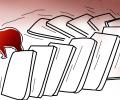
Markets face risk of a prolonged bear phase as oil shocks and geopolitical tensions test inflation, growth and investor confidence globally, points out Debashis Basu.
The shock and anger that had consumed Bear Stearns' 14,000 employees on Sunday afternoon had, by mid-week, yielded to a sense that the door of opportunity may have just opened.
In today's circumstances, however, getting people to borrow more is the last thing on the minds of financial service providers. Most of them are reeling under the weight of assets whose prices have declined precipitously because nobody in his right mind wants to buy them.
Not only has the Sensex swung wildly in the interim, staying below 10,000 for months in late 2008, but the market's winning stocks have changed in composition and character.

US President Barack Obama has released his plan to reform Wall Street. A look...
Several other European airlines have considered entering the corporate jet market, including KLM, the Dutch subsidiary of Air France-KLM, which has recently investigated the fledgling market for air taxi jet operations with four-seat very light jets. KLM has shelved the project, however, and to date only Lufthansa is pressing ahead with the development of its own fleet.
Reform will be a priority with the new Congress. But where to start?
After one of the most disastrous weeks in the history of Wall Street, Warren Buffett decided to invest $5 billion there.
Bear and Lehman are gone and ETrade is bleeding. Here's what you need to know about brokerage safety.

Inside story of how Wall Street and Washington fought to save the financial system and themselves.
Clearly the lessons of the LTCM have either not been learnt, or have been forgotten in the last nine years.
We plowed through the financials of thousands of privately held companies to find the next pockets of trouble.
Housing is not the sole problem. Instead of sub-prime, it is the Alt A loan portfolio that is at risk. Banks are not recognising the second lien on homes and mortgage rates have not fallen to the extent of interest rates. Taxpayers are borrowing more against their 401(k) savings. High crude prices are giving markets a rude shock. Outstandings in the derivatives segment are higher compared to earlier months and we happen to be in May, a notoriously bad month for equities.
Our take on everything from inflation to the credit crunch--and what it all means for small businesses.
It was a manic Monday for the Indian markets with the benchmark Bombay Stock Exchange Sensex slipping to its second biggest points' fall and the lowest since August in line with an Asia-wide slide after the Federal Reserve cut its discount interest rate at an emergency meeting and JPMorgan Chase agreed to buy sub-prime hit Bear Stearns for less than a tenth of its value last week.
US Treasuries, another key indicator of market sentiment, also slipped sharply, with June 13 seeing the largest one-day fall since 2004, with the 10-year bond yield climbing above 5.25 per cent and breaking a long-term technical resistance.

US President Barack Obama's administration has faced extensive criticism for its failure to prosecute bankers criminally for behavior that led to the financial crisis.

The US market regulator Securities and Exchange Commission was doing what it could to stem the flow. It temporarily prohibited naked short-selling in the securities of major financial players including Freddie Mac and its sister firm Fannie Mae in July. But this didn't really help. It was only after global central banks pumped in unprecedented liquidity into global markets, that the storm was finally calmed.
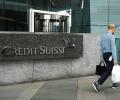
The broader economy risks a potential flight of foreign portfolio capital, therefore pressure on the rupee and more bad news on the stock market, warns T N Ninan.

For the banking system a new cycle starts in FY2024. It's fraught with fresh challenges on asset quality and profitability, warns Tamal Bandyopadhyay.
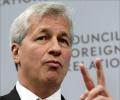
In a brief letter to his colleagues and shareholders, Dimon disclosed that the cancer was detected quickly and is confined to the original site and adjacent lymph nodes on the right side of his neck with no evidence of cancer elsewhere in his body.

Jim Rogers' decision not to invest now is not India-specific, but has to do with the problems relating to how the major global economies are shaping up.

FIFA president Sepp Blatter and its secretary general Jerome Valcke have both hired high-powered US lawyers to represent them as a corruption probe roils soccer's global governing body.

On the 10th anniversary of the global financial crisis, a multi-part series analyses the lessons learnt and those not learnt.

Indian business, on quite a different trajectory from its global counterpart, remains relatively insulated from any kind of backlash.
'I can confidently say there will be another financial crisis soon enough, and probably more than one global crisis within the next century, given the increasingly integrated nature of the global economy.'
